Accessory dwelling units (ADUs) are a growing part of the real estate market in Orange County. In areas with tight lots, high home values, city-specific permitting, older structures, and high rental demand, ADUs fill a specific need. Much of Orange County fits this description, with expensive housing, more multigenerational planning, and other conditions that drive many homeowners to maximize the value they get from their property instead of trying to buy new property.
If you want to expand your Orange County home’s living space, your two main paths are remodeling an existing space into an ADU or constructing a new ADU. What makes an ADU remodel or construction project the better choice depends on goals like rental income, family housing, and resale value.
In this guide, we cover how to align an ADU project with your personal goals.
Understanding the Two ADU Paths
First, let’s start with the important definitions.
What Is ADU Remodeling?
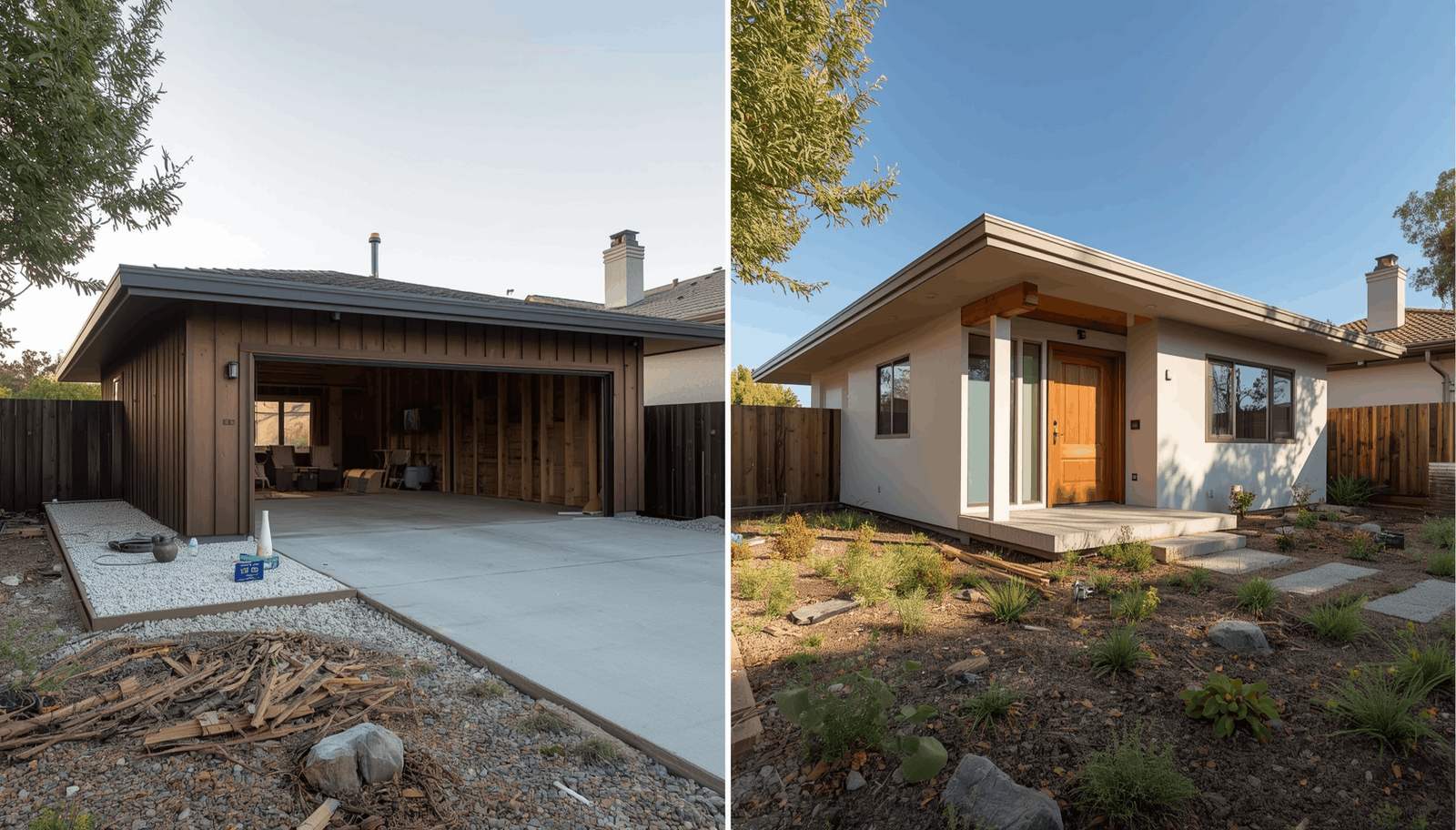
ADU remodeling occurs when you use a room or structure that was already built on your property to create an ADU. It is a specific remodeling project that meets the minimum guidelines and adds all of the features needed to legally qualify a space as an ADU.
ADU remodels are most common in attached spaces that are normally underused or overlooked, including:
- Garage conversions
- Junior ADUs (JADUs)
- Attic conversions
- Basement conversions
Interior remodels of permitted ADUs focus on maximizing functionality for day-to-day life. This involves taking any of your existing rooms/structures and taking them through a step-by-step remodel process that turns it into a functional and legally livable home.
The typical scope of ADU remodel projects includes comprehensive construction, often with demolition and/or the alteration or addition of utilities. ADU remodels include:
- Planning
- Structural preparations
- Finish construction
What Is New ADU Construction?
With new ADU construction, you are building a new self-contained residential unit on the same lot as your single-family home. An ADU can be detached or attached, meaning a backyard cottage or a new room addition built from your main structure can both qualify as ADUs.
Detached ADUs are less common and include new structures like backyard cottages, tiny homes, granny flats/pods, or other modern units. There are even prefab unit designs meant for homeowners looking to produce rental income or house their relatives.
New ADU construction is normally more expensive and complicated than a remodel, but it often produces units that are more complete and private. So, new construction makes more sense when you are trying to maximize future rent potential, offering others a more private and home-like structure to live in. But if, for example, your budget is smaller and you want to house a parent or close relative, a remodel of an existing space may be enough.
Cost Comparison in Orange County
For a quick comparison, here we break down the most likely price ranges for ADU projects in Orange County.
Total Average Cost Ranges
A normal Junior Accessory Dwelling Unit (JADU) typically costs between $50,000 and $100,000 to build, often acting as a budget-friendly alternative to full ADUs by converting existing space like bedrooms or attached garages. These 500-square-foot or smaller units usually include a kitchenette and separate entrance, with projects sometimes running from $20,000 up to $150,000+ depending on finishes.
With the exception of Junior ADUs (JADUs), most ADU remodels in Orange County cost between $100,000 and $250,000. Most fall in the middle of this range, with $150,000 being typical for a straightforward project on a clean site with a good structure. The cost may be lower than that if your property presents no unusual challenges and the scope is minimal.
Most ADU construction projects cost at least $250,000, with costs normally topping off around $500,000, but often going higher for the largest and most complex projects.
Cost Per Square Foot
The cost per square foot for an ADU remodel in Orange County is between $200 and $450.
For new construction, the range goes up to between $350 and $650. The most complex projects with the highest-quality materials may lead you to pay more per square foot.
Common Cost Drivers
- Existing utilities
- Structural condition
- Code upgrades
- Layout changes
- Electrical capacity
- Plumbing access
- HVAC requirements
- Fire separation
- Insulation and energy compliance
- Foundation condition
- Roof condition
- Windows, doors, and egress
- Site access
- Finish level
New ADU Construction Costs by Type
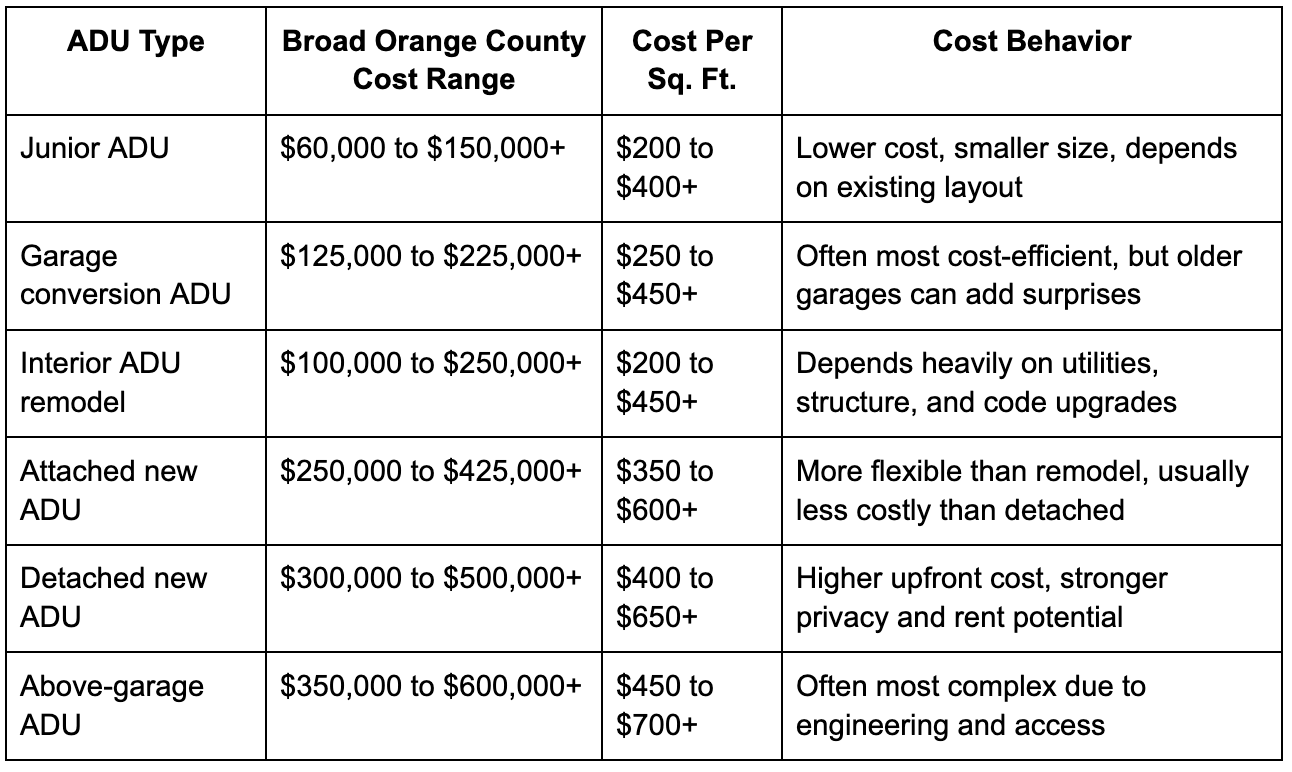
Your specific decision about where to place your new ADU can have a large immediate impact on cost estimates. For example, deciding between a garage conversion and a new ADU can create a difference of $300,000 in your budget.
Cost Predictability vs Surprise Expenses
When you are dealing with a complex project, or if you are remodeling in a particularly old home, costs can be less predictable. Overall, ADU project costs should be more predictable, and often lower, when dealing with flat terrain and modern infrastructure. But even in these cases, there may be unexpected issues that take more time to resolve. Since labor is one of the biggest components of Orange County projects, we normally suggest an emergency fund of about 10% to cover unexpected issues.
Typically, budgets for new builds are more predictable, but much higher.
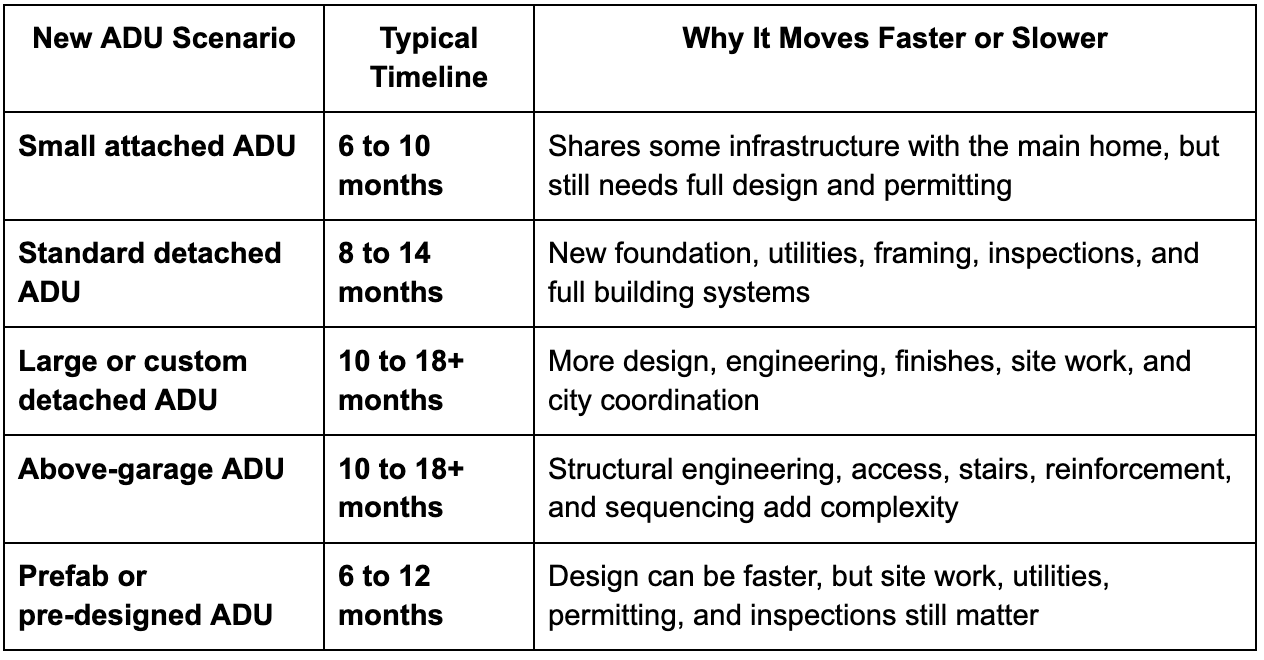
Timeline Differences
Now let’s look at the timeline differences for both approaches to Orange County ADUs.
ADU Remodeling Timelines
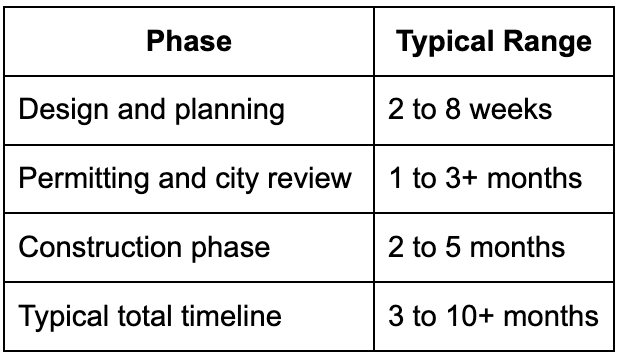
Keep in mind that remodeling instead of constructing a new structure does not necessarily mean you won’t have extensive permitting and review responsibilities. The line between an ADU and a typical living space is well-defined, with ADUs having clear minimum standards.
So, if you’re remodeling instead of constructing, you can usually expect a shorter timeline overall. However, a highly complex remodel can in some cases take longer than a simple ADU construction project.
H3: New ADU Construction Timelines
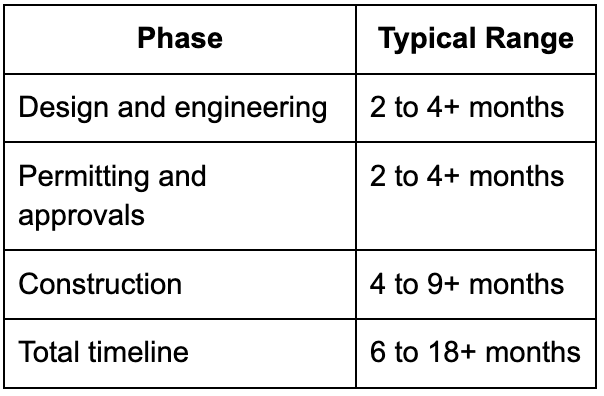
Because ADU construction means building a structure from the ground up, it usually takes longer to design, engineer, permit, and approve. Construction timelines can vary widely, depending on factors such as hillside construction or difficulty connecting to utilities. In these cases, timelines may need to be extended.
Permitting and Zoning Considerations in Orange County
In this section, we focus on the differences in permitting and zoning considerations for ADU projects in Orange County.
Permits for ADU Remodeling
In Orange County, permits are handled in two layers:
- Statewide ADU laws
- Local cities’ review processes
California ADU law typically requires local agencies to review your ADU applications and approve or deny them within 60 days. However, if your project plans change or are not complete when you submit them, the project timeline can be extended. Sometimes, local site conditions also lead to more review needs.
The typical permits required are:
- Building permits
- Electrical permits
- Plumbing permits
- Mechanical or HVAC permits
- Structural review for code compliance in older buildings, in some cases
- Energy compliance, in some cases
The hardest cases are often those where rooms or spaces in older homes are being remodeled into an ADU, such as a garage conversion. The typical challenges you may encounter include not meeting current requirements for:
- Insulation
- Ceiling height
- Fire separation
- Foundations
- Electrical capacity
- Plumbing
- Ventilation
- Safe access
Permits for New ADU Construction
For new ADU construction, you typically need a more complete version of the same type of checklist. Your city has to approve the project from the ground up. So, the main difference with new ADU construction is that you will also need to consider:
- The new structure
- New or extended utilities
- Foundation work
- Framing
- Energy compliance
- Drainage
- Site planning
Orange County Public Works defines the county’s ADU guidance with a four-foot side and rear setback and a 1,200-square-foot maximum for detached ADUs. However, each city in OC applies its own local standards.
City-by-City Variations
Orange County’s ADU rules can vary by city. Statewide regulations are established with amendments to the California Government Code, Sections 65852.2 and 65852.22.
Projects in Anaheim, Irvine, Huntington Beach, Santa Ana, Costa Mesa, Fullerton, or Newport Beach follow the same statewide ADU framework. However, the submittal process, review expectations, zoning details, and local interpretations are different in each city.
These local considerations are another reason local experience matters. Choosing the right contractor helps create a smoother process, as this portion of each project depends on knowing how your city reviews ADUs, what documents are needed upfront, and where projects commonly get delayed.
ROI, Rental Income & Property Value Impact
ADU projects are normally made with long-term value in mind. In this section, we look at the difference between ADU remodeling and new ADU construction ROI.
ROI of Remodeling an Existing ADU
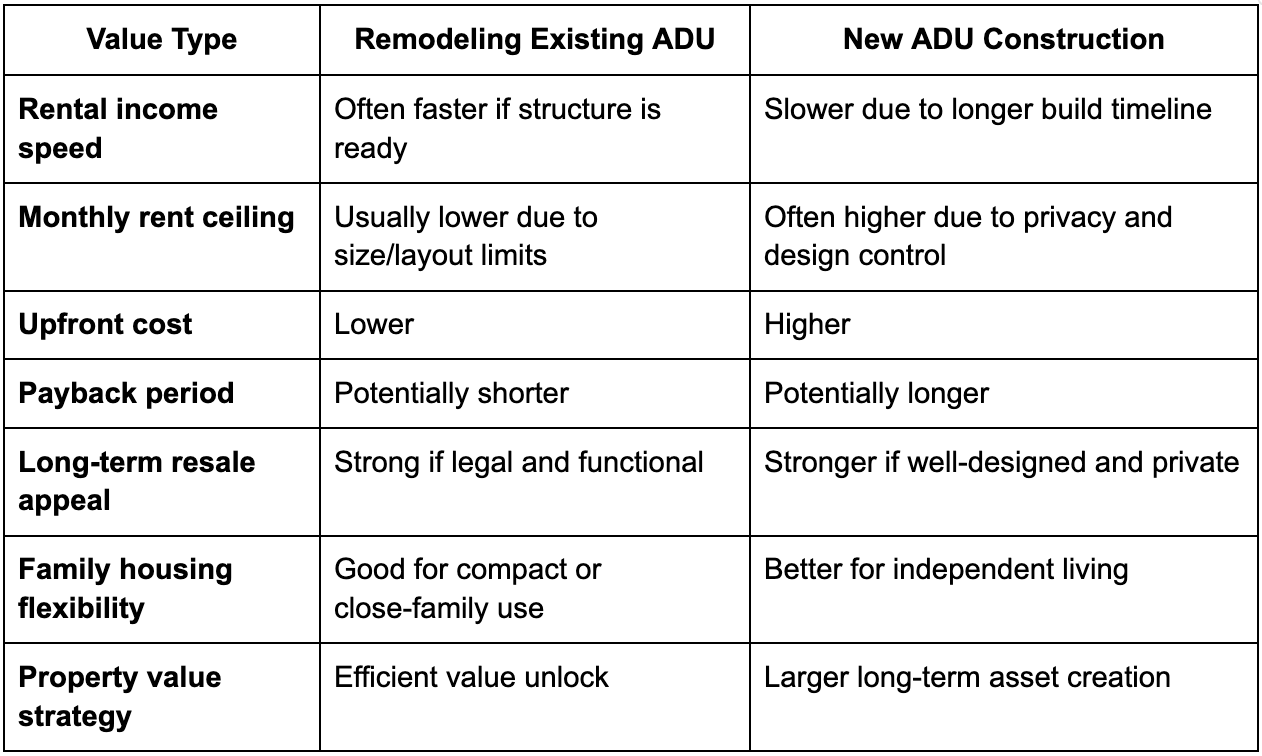
In Orange County, ADU ROI is often about how quickly a project can start producing value, rather than only immediate resale value. Based on our experience, it is normally safer and more approachable to use a strategy focused on long-term value appreciation and personal satisfaction, while staying aligned with local market expectations to guard your investment.
For remodeling a space into an ADU, you can usually expect a lower upfront investment and a faster progression into rental income. However, in the long term, you will face limitations based on the size and rent potential of your converted or remodeled ADU. So, the final result is shaped largely by what already exists.
ROI of New ADU Construction
A new ADU is a much larger investment with a longer-term ROI goal. If you have the space and are comfortable with a longer payback period, a brand-new ADU offers the potential for stronger long-term value.
Overall, if you choose a new ADU construction project, what you can expect includes:
- Higher construction costs
- Strong long-term appreciation
- Higher rental income ceilings
ADUs as Long-Term Assets
It can be more useful to break down how each choice may reflect your goals. Have a look at these common ROI goals and how each ADU type can support them.
Use Cases: Which Option Fits Your Goals?
In this section, we look at specific use cases where either ADU remodeling or new ADU construction makes more sense.
ADU Remodeling May Be Best If:
- You already have a garage, JADU space, or permitted structure that can be legally converted
- Your existing structure is in good enough condition to reuse
- Your budget is a primary concern
- You want a faster path to rental income or family housing
- You are comfortable working within your home’s existing footprint
- You want to house a parent, adult child, guest, or caregiver
- You want to improve an existing ADU’s layout, finishes, or livability without rebuilding from scratch
New ADU Construction May Be Best If:
- You want to maximize rental income potential
- You need more square footage than your existing structure allows
- You want more privacy and separation from the main home
- You are planning for long-term property value
- Your garage or existing structure is too limited, damaged, or costly to convert
- You want more control over layout, access, storage, natural light, and overall design
- Your lot has enough usable space to support a larger or better-positioned ADU
Risks & Considerations to Keep in Mind
An ADU is an investment. Like every investment, there are risk factors and considerations you should understand.
ADU Remodeling Risks
- Your existing structure may have foundation, framing, roof, or moisture issues
- Older garages or additions may not meet current code requirements
- You may need major upgrades for electrical, plumbing, or HVAC systems
- Ceiling height, insulation, windows, or fire separation may limit what is possible
- Demolition may reveal hidden issues only after it begins
- The final layout may be constrained by the existing footprint
- Cost savings can shrink if too many changes to the structure are needed
New ADU Construction Risks
- Upfront investment is usually higher than when remodeling
- The total timeline may be longer when the project starts from the ground up
- Site access can affect construction cost, equipment use, and scheduling
- You may need work on utility connections, sewer lines, drainage, or electrical upgrades
- You may face design limits from setbacks and lot coverage
- Custom designs can create more decision points and potential delays
- Time to rental income generation is longer and time estimates have longer ranges
Choosing the Right Contractor for Your ADU Project
Contractors do a lot, especially when it comes to larger, more tightly regulated projects like ADUs. Specific local experience is what tends to create the best outcomes.
Why ADU Experience Matters
Local experience can be one of the biggest time and money savers when working with ADUs. The right local experts can help you navigate state and local ADU laws, avoid permit delays, and maximize the accuracy of your cost and timeline estimates.
{{cta-banner}}
Design-Build vs Traditional Contracting
ADU projects always go beyond construction. For new construction or remodeling, there are also design, permitting, budgeting, and utility planning considerations.
In practice, this looks like different professionals acting as a team. Bringing people together like this can create new challenges when communication gaps arise. Often, the biggest risks are not from the build itself, but from gaps between design, budget, permitting, construction, and so on.
Design-build teams close the gaps between each professional. These teams are integrated from the start, keeping the process streamlined between professionals who are equipped to coordinate their efforts.
Final Takeaway
There is no one-size-fits-all answer for whether you should choose an ADU remodel or new ADU construction on your property. The best option is always based on your:
- Budget
- Timeline
- Lot conditions
- Long-term goals
If you want the best possible outcome, dealing with the strategic planning upfront is what prevents costly mistakes later. We can help you find the right design-build team to complete a renovation that adds income-producing space to your property.
How much is your home's worth?
Get your personalized estimate today.













Jonathan Salas brings a wealth of experience to Revive, having started in real estate in 2007 and later founding Above Media in 2012. His expertise in real estate marketing and innovative technology has helped Revive since year one. As Head of Sales, Jon helps homeowners and agents navigate the challenging world of renovations.